
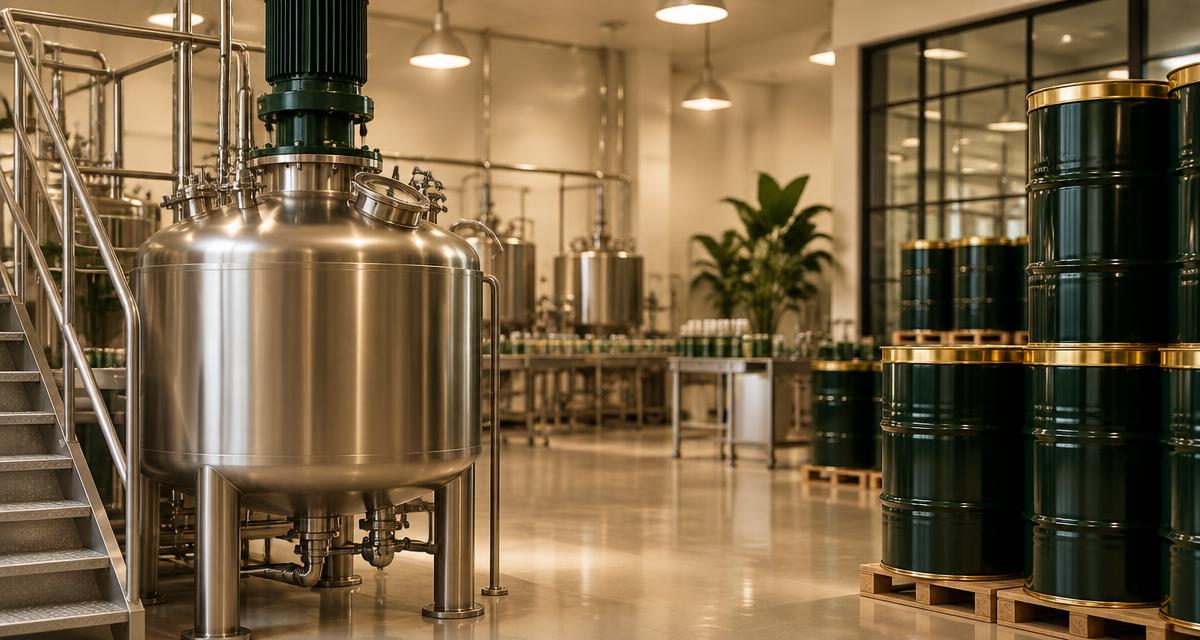
Contract manufacturers quote minimums in litres because production happens in a mixing vessel, and a batch below a certain volume cannot be controlled reproducibly. At 300 litres per SKU, a first order becomes roughly 3,000 units at 100 ml or 300 units at 1 litre. Packaging, artwork, testing and registration, not the liquid, drive most of the first-order cost.
- MOQ is per SKU, in litres, because each formula is a separate batch.
- 300 litres converts to ~1,200 units at 250 ml or ~600 at 500 ml.
- Fewer SKUs deeper usually beats many SKUs at the minimum.
- Packaging and registration often cost more than the formula itself.
- Plan the reorder point before the first order lands.
The first question every brand asks a hair care contract manufacturer is the minimum order quantity. The answer is more useful once you understand why factories measure it in litres rather than units, and how that converts into the stock you will actually receive.
Why MOQ is measured in litres
Production happens in a mixing vessel, not in bottles. Below a certain volume, a batch cannot be mixed, heated and homogenised to a reproducible standard, and quality control sampling stops being meaningful. The minimum therefore reflects the smallest batch the plant can produce consistently — which is a volume, not a unit count.
Ours is 300 litres per SKU, for both finished goods and bulk drums.
What 300 litres becomes on your shelf
| Fill size | Approximate units from 300 L | Typical use |
|---|---|---|
| 100 ml | ~3,000 | Retail leave-in, serum, travel |
| 250 ml | ~1,200 | Retail shampoo, conditioner |
| 500 ml | ~600 | Retail mask, salon back-bar |
| 1 L | ~300 | Professional smoothing, salon size |
Unit counts are approximate: fill tolerance, overfill allowance and production losses all move the final figure slightly. The pattern to notice is that the same minimum produces a very different stock position depending on the pack size you choose.
One SKU deep, or several SKUs at the minimum?
New brands often want to put their whole budget into a single hero product. In practice, distributors and salons buy ranges. Four SKUs at 300 litres each usually sells faster than 1,200 litres of one product, because it gives the buyer a service system rather than an item.
What actually drives your first-order cost
- Packaging: bottles, caps, pumps and cartons, often the largest single line.
- Artwork and printing setup, charged per SKU regardless of volume.
- Stability and packaging compatibility testing.
- Regulatory registration or notification in the destination market.
- Formula cost per litre — usually smaller than brands expect.
- Freight, insurance, duty and customs clearance.
Because four of those six lines are fixed per SKU, cutting volume below the minimum would not reduce your cost per unit — it would increase it. That is the economic logic behind the MOQ, not a sales tactic.
Contract manufacturing, OEM, ODM: the vocabulary
- Contract manufacturing: a factory produces on your behalf under an agreement.
- OEM: you supply the specification or an existing formula, the factory produces it.
- ODM: the factory develops the formula and you brand and sell it.
- Private/white label: the commercial outcome — the product carries your brand.
Most real projects mix these: a catalogue base for two SKUs, a custom development for the hero product, all produced under one contract. The models are compared in private label manufacturers and white label hair products.
Planning the reorder before the first order
Decide up front what triggers your second production run: a stock level, a sell-through rate, or a date. Lead time does not start when you run out — it starts when you place the order, and packaging supply is usually the long pole. Brands that set a reorder trigger at launch avoid the stockout that kills momentum in month four.
What is Eco Beauty's minimum order quantity?
300 litres per SKU, available as finished branded goods or as bulk drums for local filling.
Can I mix several SKUs to reach the minimum?
No — the minimum applies per SKU because each formula is a separate production batch. You can, however, order several different SKUs at the minimum in the same shipment.
Is bulk cheaper than finished goods?
Per litre it usually is, and freight is more efficient, but you take on filling, labelling and local compliance. The comparison is worked through in our bulk supply guide.
Next step
Send us your SKU list, fill sizes and destination market and we will quote the full first order, including packaging and freight. Request a quote.
Build your line with a Brazilian manufacturer.
Full service or bulk supply, from 300 litres per SKU, with export documentation for the EU, US and Gulf markets.
Request a quote