
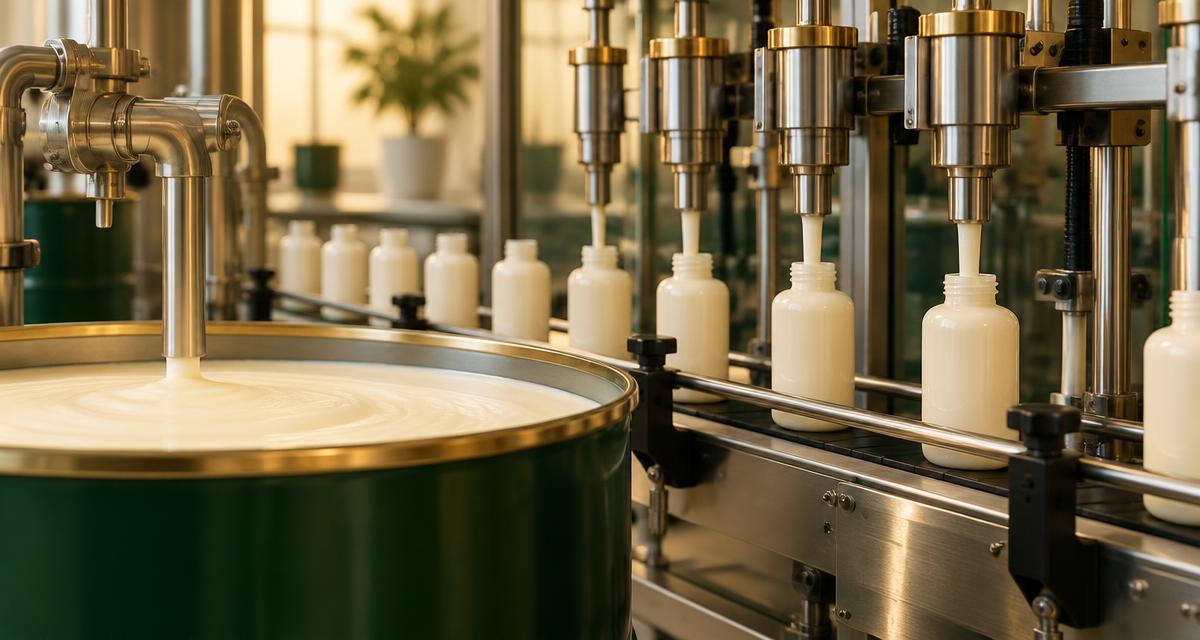
Buying bulk cosmetics in drums or IBCs cuts freight and duty because you stop shipping air and packaging, but it moves filling, batch control and part of the stability responsibility to your side. It works when the local filling site is qualified, the import documentation covers bulk rather than finished goods, and the split of stability responsibility is written down before the first drum ships.
- Bulk lowers freight and duty per litre, sometimes dramatically.
- Your filling site must be qualified before the first drum lands.
- Stability responsibility divides at the moment you open the drum.
- Import documentation for bulk differs from finished goods.
- Minimum stays 300 litres per formula, drums or finished units alike.
A finished 250 ml bottle is mostly air, plastic and cardboard travelling across an ocean. Bulk supply removes that: the formula ships in drums or IBCs and is filled close to the market. For distributors with local filling capacity, or brands facing high import duty on retail goods, it is usually the better economics.
What bulk supply actually includes
- The finished formula, manufactured and quality-controlled, in drums or IBCs.
- Certificate of analysis per batch, with the specification the filler must verify against.
- Full quantitative formula and INCI listing for registration and labelling.
- MSDS, stability report and challenge test data.
- Handling, storage and filling guidance: temperature range, agitation, viscosity behaviour, compatible contact materials.
Bulk versus finished goods
| Factor | Finished goods | Suministro a granel (Bulk) |
|---|---|---|
| Freight volume | High — packaging travels | Low — formula only |
| Import duty base | Retail-ready product value | Often lower tariff on bulk preparations |
| Packaging control | Factory sourced and assembled | Local sourcing, faster artwork changes |
| Time to shelf | Arrives ready to sell | Adds a local filling cycle |
| Quality responsibility | Single point — the manufacturer | Shared between manufacturer and filler |
| Ideal para | Brand launches, retail programmes | Distributors, high-duty markets, salon volumes |
Where stability responsibility divides
This is the clause bulk contracts most often leave vague. The clean division is: the manufacturer guarantees the bulk against its specification, for a defined shelf life, when stored and handled within the stated conditions. Everything that happens once the drum is opened — filling environment, hygiene, chosen packaging, closure, headspace, transport to shelf — belongs to the filler.
That means the filler must run its own packaging compatibility test with the actual pack it intends to use. Our stability data covers the formula, and covers packaging only for the packs we ourselves fill. A different bottle, liner or pump is a different system.
What a local filling site needs to be ready for
- GMP-compliant filling environment with documented cleaning and line clearance.
- Microbiological control at filling — this is where contamination risk concentrates.
- Incoming goods check against the certificate of analysis before opening the drum.
- Packaging compatibility testing for each pack format used.
- Batch traceability that links the bulk batch number to every filled unit.
- Retention samples and its own release testing.
- Labelling that meets the destination market's rules, including the correct responsible entity.
Practical handling notes
- Store drums shaded, at a stable temperature, away from freeze-thaw cycles.
- Some emulsions and high-viscosity masks need gentle homogenisation before filling; check the technical sheet rather than assuming.
- Record the date a drum is first opened and fill it out within the stated window.
- Never top up a partly used drum from another batch — traceability breaks immediately.
- Match contact materials to the formula; acid smoothing systems are particularly sensitive to metal contact.
Documentation for import as bulk
Bulk preparations may classify under a different HS code than retail-packed cosmetics, which is often the source of the duty saving — confirm the classification with your broker before quoting margins. You will still need the certificate of free sale, certificate of origin, batch COA and MSDS, and in most markets the finished, locally filled product still requires its own notification or registration under the local filler's or brand's name.
What is the minimum for bulk supply?
300 litres per SKU, the same minimum as for finished goods.
Do you guarantee shelf life of bulk we fill ourselves?
We guarantee the bulk against its specification for the stated shelf life under the stated storage conditions. Once filled locally, the filler owns the finished-product stability in its own packaging, which is why packaging compatibility testing on your pack is essential.
Can you supply the same formula as bulk and as finished goods?
Yes. Many clients launch with finished goods for retail, then move volume lines to bulk once local filling is set up.
What documents come with a bulk shipment?
Certificate of analysis per batch, full formula and INCI, MSDS, stability report, challenge test data, certificate of free sale and certificate of origin.
Cree su línea con un fabricante brasileño.
Servicio integral (Full Service) o suministro a granel (Bulk), desde 300 litros por SKU, con documentación de exportación para los mercados de la UE, EE. UU. y el Golfo.
Solicitar presupuesto